
Psychotherapy for Self-Discovery: Uncovering the Depths of the Unseen Self

What if the persistent feeling of searching for something isn't a sign that you're lost, but a signal that your unconscious self is waiting to be acknowledged? Many high-achieving individuals in the UK navigate successful careers while feeling like an imposter in their own lives. You might recognise the exhaustion of repeating self-sabotaging patterns or the quiet weight of an unexplained emptiness that persists despite your accomplishments. It's a common experience to feel as though you're performing a role rather than truly inhabiting your existence.
Engaging in psychotherapy for self discovery offers a way out of this performance. It moves beyond the temporary relief of symptom management to facilitate a profound, lifelong integration of your true identity. By turning your attention inward with patience and serious reflection, you can move from a state of searching to one of being. This article explores how depth psychotherapy uncovers the hidden drivers of your behaviour, integrates the "shadow" self into your personal and professional life, and cultivates the authenticity required for genuine resilience.
Key Takeaways
- Understand how psychotherapy for self discovery differs from lifestyle changes by focusing on the foundational architecture of your personality rather than external pursuits.
- Learn to identify the "shadow" elements of your psyche-those repressed parts of yourself that often manifest as persistent imposter syndrome or professional burnout.
- Discover why surface-level interventions may feel insufficient for overachievers and how depth work prioritises long-term meaning-making over mere symptom reduction.
- Recognise the psychological signals, such as a mid-life transition or a sense of "searching," that indicate you are ready for a serious journey of inner inquiry.
- Explore the practical considerations for engaging with a private psychotherapist in the UK who can serve as a steady, intellectual anchor for your personal evolution.
Beyond the Surface: What is Psychotherapy for Self-Discovery?
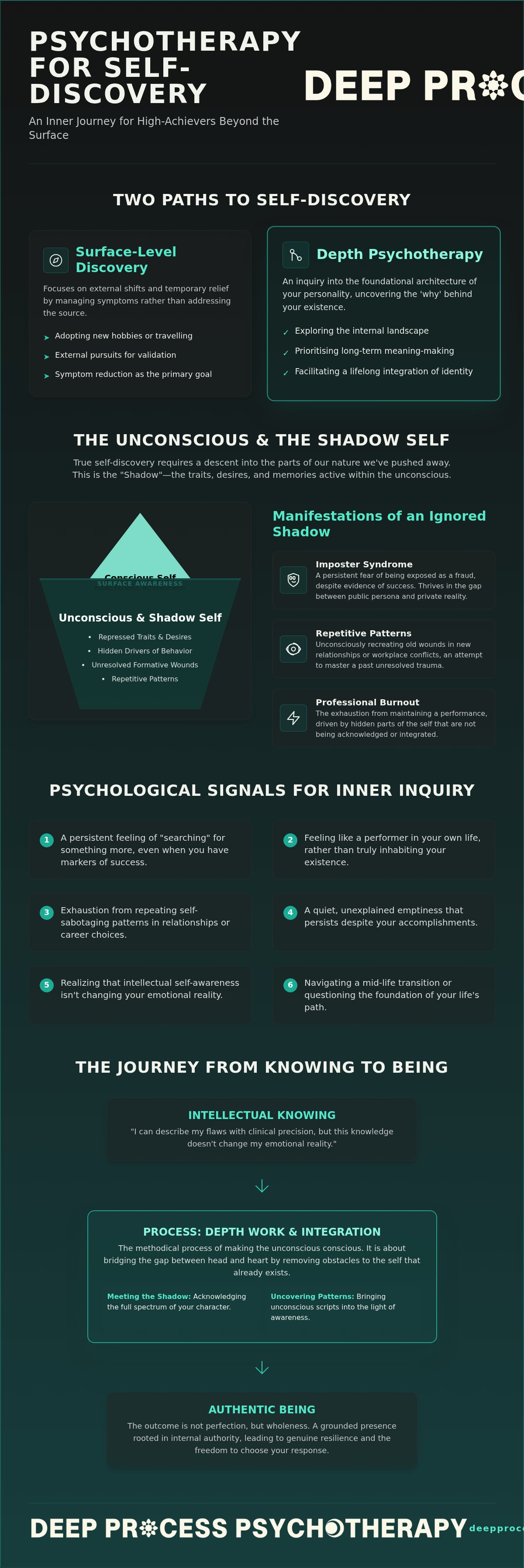
Psychotherapy for self discovery is a deliberate, methodical inquiry into the foundational structures of the personality. While lifestyle self-discovery often involves external shifts, such as travelling or adopting new hobbies, this work focuses exclusively on the internal landscape. It's an exploration of the architecture that supports your thoughts, reactions, and relationships. This process is often the byproduct of individual psychotherapy sessions, where the focus shifts from managing daily stress to understanding the reasons behind your existence. The self is not a static destination you arrive at; it's a continuous process of uncovering layers that have been obscured by time and survival.
The Distinction Between Knowing and Being
Many people enter therapy with a high degree of intellectual self-awareness. They can describe their childhoods or list their flaws with clinical precision, yet they find that this knowledge doesn't change their emotional reality. Insight-oriented psychotherapy seeks to bridge the gap between the head and the heart. It's one thing to understand a problem; it's quite another to experience a shift in your very being. Engaging in psychotherapy for self discovery allows you to look past the symptoms of your discontent to the source. "Self-discovery is less about finding a new version of the self and more about removing the obstacles to the one that already exists."
Why Successful Professionals Seek Inner Inquiry
Successful professionals often reach a point where external validation no longer fills the internal hollows. You might have the career, the status, and the material markers of success, yet feel a persistent sense of searching. This work facilitates a transition from relying on external benchmarks to establishing a firm internal authority. For a leader, this depth of inquiry isn't a luxury; it's a necessity. It supports professional development by ensuring your decisions are rooted in authenticity rather than reactive patterns or a need for approval. This clarity allows for a more grounded presence in both the boardroom and the home.
The Role of the Unconscious and the Shadow Self
True self-discovery is rarely a comfortable ascent. It is often a descent into the parts of our nature we've spent decades ignoring. Carl Jung termed this the Shadow. These are the traits, desires, and memories we've pushed away to fit into society or to survive our formative years. While we might believe these parts are gone, they remain active within the unconscious. They often announce themselves through professional burnout or a nagging sense of being a fraud. In the context of psychotherapy for self discovery, we don't seek to fix these parts. Instead, we seek to meet them. Understanding these hidden drivers is supported by the American Psychiatric Association on psychotherapy, which highlights how exploring personal history can resolve current emotional conflicts.
When we ignore the shadow, we create a gap between our public persona and our private reality. This gap is where imposter syndrome thrives. If you find yourself constantly fearing exposure despite your achievements, you might benefit from exploring therapy for imposter syndrome UK to address this underlying fragmentation. True discovery requires the courage to look at what we usually turn away from. Only by acknowledging the full spectrum of our character can we begin to live with genuine authority.
Uncovering Repetitive Patterns
Why do we choose the same difficult partners or find ourselves in identical workplace conflicts? This is often the repetition compulsion. It's an unconscious attempt to master an old wound by recreating it in the present. Within the space of 1:1 sessions, these scripts are brought into the light of awareness. Unconscious patterns are the invisible architecture of our daily choices. Once you see the blueprint, you're no longer forced to live inside it. You gain the freedom to choose a different response.
Integrating the Shadow for Authenticity
Integration is the process of making the unconscious conscious. It's not about becoming perfect; it's about becoming whole. This leads to a sense of being weighted or grounded. You stop drifting because you finally know what you're made of. In a professional context, this is explored through The Shadow At Work. This framework helps leaders understand how their hidden insecurities influence their management style and team dynamics. For those ready to begin this reflection, our Substack newsletter offers a consistent space for ongoing inquiry and psychological depth.
Depth Psychotherapy vs. Surface-Level Interventions
When seeking support, it's common to encounter modalities like Cognitive Behavioural Therapy (CBT) which focus primarily on symptom reduction. These approaches are often designed to alleviate specific anxieties or adjust problematic behaviours through structured exercises. While useful for immediate relief, psychotherapy for self discovery requires a different orientation. Instead of asking how to stop a symptom, we ask what that symptom is trying to communicate about your internal world. This transition from "fixing" to "meaning-making" is essential for those who have found that traditional coaching or short-term interventions leave their deeper questions unanswered. This distinction is vital when considering how psychotherapy can help with long-term internal conflicts rather than just temporary crises.
The therapeutic relationship itself serves as a profound mirror in this process. Unlike a mentor or a friend, a psychotherapist provides a steady, neutral presence that reflects your unconscious drivers back to you. This reflective space allows you to see the parts of your identity that are usually hidden behind professional masks or social expectations. For individuals with demanding schedules, engaging in depth psychotherapy online ensures that this vital mirror remains accessible, allowing for consistent inner work despite geographical or professional constraints.
The Limitation of "Quick Fixes"
Modern mental health services often mirror the efficiency-driven values of the corporate world. There's a persistent pressure to achieve "results" in six to ten sessions. However, the soul does not operate on a corporate timeline. Deep process requires a rhythmic, patient approach that allows for the natural unfolding of the self. Trying to rush self-discovery is a contradiction in terms; it's a journey that demands a slowing down to notice the subtle nuances of your internal state. True transformation is a slow build, not a sudden shift.
A Comparison of Approaches
Understanding which path to take depends on your desired outcome. While goal-oriented therapy is excellent for functional coping, process-oriented work is necessary for psychological integration. Deep Process Psychotherapy acts as a bridge between high-level psychological theory and the practical reality of your personal growth.
| Feature | Goal-Oriented Therapy (CBT/Coaching) | Process-Oriented Therapy (Depth) |
|---|---|---|
| Primary Focus | Symptom management and habit change. | Understanding the unconscious and the self. |
| Timeline | Short-term, often linear and structured. | Long-term, rhythmic, and unfolding. |
| Core Outcome | Functional coping and skill building. | Psychological integration and authenticity. |
| Approach | Instructional and goal-driven. | Inquiry-based and reflective. |
Signs You Are Ready for a Journey of Inner Inquiry
The threshold for entering psychotherapy for self discovery is rarely crossed during a moment of explosive crisis. Instead, it's typically approached through a quiet, persistent sense of dissonance. You might find that the life you've meticulously built, your professional standing, your relationships, and your social contributions, no longer seems to belong to you. This feeling of living someone else's life is a common precursor to depth work. It suggests that the structures you created for survival or success in your twenties and thirties have become too small for the person you're becoming. These signals are often quiet, yet they possess a gravity that cannot be ignored indefinitely.
These signals often arrive during significant developmental milestones. The Mid-Life Transition or the Quarter-Life Crisis are frequently dismissed as clichés, yet they represent profound psychological shifts. They are calls to move beyond the demands of the external world and begin the work of inner inquiry. If you find yourself "having it all" by conventional UK standards but feeling a strange, unnamable lack, you're likely standing at this threshold. It is a moment where the ego's achievements are no longer enough to sustain the soul's requirements.
The Experience of the "Inner Void"
The inner void is not a sign of failure; it's a psychological signal for growth. It manifests as a subtle sense of lack that persists even after a major promotion or a personal achievement. This void acts as an invitation to explore the internal landscapes you may have neglected in your pursuit of external security. It's the psyche's way of saying that the current level of meaning is no longer sufficient. By acknowledging this emptiness, you begin the process of uncovering what lies beneath the surface of your daily routines. This void is not a vacuum to be filled with more activity; it's a space waiting for the resonance of the true self.
When Success Feels Like a Performance
For many high-achievers, professional life becomes a series of well-rehearsed performances. You maintain a persona of competence and control, yet the effort required to keep this mask in place is becoming exhausting. This fraudulent self is a heavy burden to carry, leading to a specific type of fatigue that rest cannot cure. Psychotherapy for self discovery provides a contained, professional space where this mask can be safely lowered. This isn't merely about personal relief; it's essential for authentic leadership. A leader who has integrated their own internal conflicts possesses a higher degree of emotional intelligence and a more grounded presence. If you recognise these patterns in your own life, you may be ready to explore 1:1 therapy to begin your own process of integration.
Beginning the Journey: How to Engage with Depth Work
Embarking upon psychotherapy for self discovery is an act of profound courage. It marks the transition from seeking external solutions to making a long-term investment in your psychological capital. In the UK, the process of finding a private psychotherapist should be approached with the same discernment one brings to any significant developmental undertaking. It's essential to find a practitioner who offers a steady, intellectual presence, someone capable of acting as a stable anchor while you navigate complex internal territories. This professional relationship creates the necessary distance from your daily roles, allowing you to observe the patterns that solitary reflection often fails to illuminate.
The Therapeutic Container
The 1:1 session serves as a dedicated container for deep process. In this space, the urgent demands of a career are replaced by a methodical and thorough inquiry into the self. A session often begins with a broad conceptual framework, perhaps a recurring dream or a persistent feeling of professional burnout, and then moves toward a clarifying personal resonance. This transition from theory to practical reality is where integration occurs. We ensure this depth of work is accessible across the UK by offering online sessions, providing a consistent and safe environment for exploration regardless of your location. This allows psychotherapy for self discovery to remain a steady priority amidst a demanding schedule.
Ongoing Growth Beyond the Room
As the work progresses, the insights gained during your sessions begin to permeate your daily life. Shadow work evolves from a weekly appointment into a persistent habit of mind. You start to notice the unconscious drivers behind your leadership decisions or the hidden fears that influence your personal relationships. This continuous engagement is supported by our Substack newsletter, which offers a space for ongoing reflection and psychological depth between sessions. Over time, this integration leads to a more grounded and authentic presence in all areas of existence. If you're ready to begin this evolution, we invite you to explore our 1:1 therapy sessions or our corporate workshops focused on the Shadow at Work.
Cultivating a Life of Authentic Integration
The journey toward a more integrated existence isn't a project to be completed, but a lifelong evolution to be embraced. By moving beyond the immediate relief of symptom management, you create space for a more profound dialogue with your internal landscape. We've explored how the hidden drivers of the unconscious, once acknowledged, can transform from sources of self-sabotage into foundations for genuine leadership and personal authority. This depth of work is what distinguishes psychotherapy for self discovery from more superficial interventions. It's a serious investment in the very architecture of your being.
As the founder of "The Shadow At Work," I've seen how this commitment to long-term psychological evolution provides a stable anchor in an increasingly fragmented world. Our national UK service offers the professional container necessary for this reflection, ensuring that your inquiry remains grounded and methodical. You don't have to navigate these complex internal territories alone. Begin your journey of inner inquiry with Deep Process Psychotherapy and discover the resilience that comes from truly knowing yourself. The path toward authenticity is open to those ready to listen.
Frequently Asked Questions
Is psychotherapy for self-discovery different from standard counselling?
Yes, it focuses on foundational structures rather than just current problems. Counselling often addresses specific life events or immediate distress. In contrast, psychotherapy for self discovery involves a deeper inquiry into the personality's architecture. It examines the unconscious drivers that influence your long-term patterns. This approach prioritises meaning-making and integration over simple symptom reduction, offering a more thorough exploration of the self's evolution.
How long does the process of self-discovery through therapy typically take?
The process is rhythmic and unfolding rather than linear, often requiring months or years for profound integration. Unlike short-term interventions that target quick fixes, depth work respects the soul's natural timeline. The duration depends on your personal history and the complexity of the layers being uncovered. It's a long-term investment in your psychological capital, designed to foster resilience and authenticity that endures throughout your life.
Can I benefit from self-discovery therapy if I am not currently depressed or anxious?
Yes, many individuals seek this work to address a persistent sense of emptiness or unfulfillment despite their successes. You don't need to be in a state of crisis to engage with inner inquiry. Often, the motivation is a desire for greater authenticity or a shift from external validation to internal authority. Therapy provides a stable anchor for those navigating the quiet dissonance of a life that feels like a performance.
What is the "shadow self" and why does it matter for my career?
The shadow self comprises the repressed or ignored parts of your nature that still influence your behaviour. In a professional context, these hidden traits often manifest as imposter syndrome, burnout, or self-sabotaging leadership patterns. By integrating the shadow through the "Shadow At Work" framework, you gain a more grounded presence. This awareness prevents unconscious insecurities from dictating your management style, leading to more authentic and effective professional relationships.
How do I know if I need a therapist or a life coach for self-discovery?
Therapy is necessary when you wish to explore the unconscious drivers and historical patterns that govern your current reality. While life coaching typically focuses on future goals and external action, depth psychotherapy addresses the internal architecture of the person taking those actions. If you find yourself repeating the same self-sabotaging patterns despite your best efforts, a therapist can help you uncover the blind spots that coaching often misses.
Is depth psychotherapy available online for clients across the UK?
Yes, we provide national UK coverage through secure online sessions that maintain the depth of 1:1 work. This accessibility ensures that those with demanding professional schedules can engage in consistent reflection regardless of their location. The online container is carefully established to provide the same sense of safety and intellectual presence found in traditional settings, allowing for a methodical exploration of psychotherapy for self discovery from your own space.
What should I expect in my first session of self-discovery therapy?
Your first session is an initial inquiry into your current internal state and the patterns that have led you here. It's a space for mutual discovery where we begin to outline the broad conceptual frameworks of your life. You can expect a calm, steady atmosphere focused on understanding your unique perspective rather than a rushed clinical assessment. This meeting establishes the foundation for the deep process and the rhythmic work that follows.
Does Deep Process Psychotherapy offer resources for those not ready for 1:1 work?
Yes, we provide several avenues for engagement for those who prefer a different pace of reflection. Our Substack newsletter offers regular psychological insights and prompts for internal inquiry that you can explore independently. Additionally, our corporate workshops and the "Shadow At Work" framework provide structured environments to engage with depth psychology concepts. These resources serve as a bridge between high-level theory and the practical reality of your personal growth.