
Individual Psychotherapy Sessions: A Journey into Depth and Integration

What if the very traits that secured your professional success are now the invisible barriers preventing your personal fulfillment? Many high achievers find themselves at a peculiar crossroads where traditional accolades no longer mask a growing sense of internal misalignment, leading them to seek individual psychotherapy sessions that offer more than mere symptom management. It's common to feel a persistent exhaustion that no amount of rest can touch, or perhaps you've noticed recurring patterns in your leadership and relationships that seem to sabotage your progress despite your best intentions. You aren't alone in feeling stuck even when the world sees you as thriving.
This exploration moves beyond the superficial to show how a dedicated therapeutic process fosters profound psychological integration and a renewed sense of professional sovereignty. We'll examine the journey of uncovering the shadow self and how stabilizing your internal landscape provides the necessary foundation for genuine emotional intelligence and purpose. By the end, you'll understand how these sessions serve as a laboratory for the soul, allowing you to bridge the gap between high-level psychological theory and the practical reality of your long-term evolution.
Key Takeaways
- Learn why moving beyond temporary coping mechanisms is the first step toward achieving the deep, structural psychological change required for lasting fulfillment.
- Understand how individual psychotherapy sessions create a bridge between your daily professional life and the profound insights found within your unconscious mind.
- Discover the ways the "Shadow at Work" framework helps you identify and resolve the unconscious patterns that may be hindering your growth in high-stakes environments.
- Recognise the therapeutic alliance as a vital, steady anchor that provides the safety needed to navigate and integrate complex internal landscapes.
- Gain a clearer perspective on how psychological integration fosters a sense of internal stability and authentic professional sovereignty.
Beyond Symptom Relief: The Purpose of Individual Psychotherapy Sessions
Many people first approach Psychotherapy when the weight of their internal world becomes too heavy to carry alone. While initial relief from symptoms like anxiety or burnout is a natural goal, the true purpose of individual psychotherapy sessions extends far beneath the surface of immediate distress. It's a dedicated space for deep psychological inquiry, where we don't merely seek to silence a symptom but to understand what that symptom is trying to communicate about your internal architecture. As of 2026, UK practitioners within private practice must adhere to strict professional registration standards, reflecting a national commitment to high-level clinical integrity and patient safety.
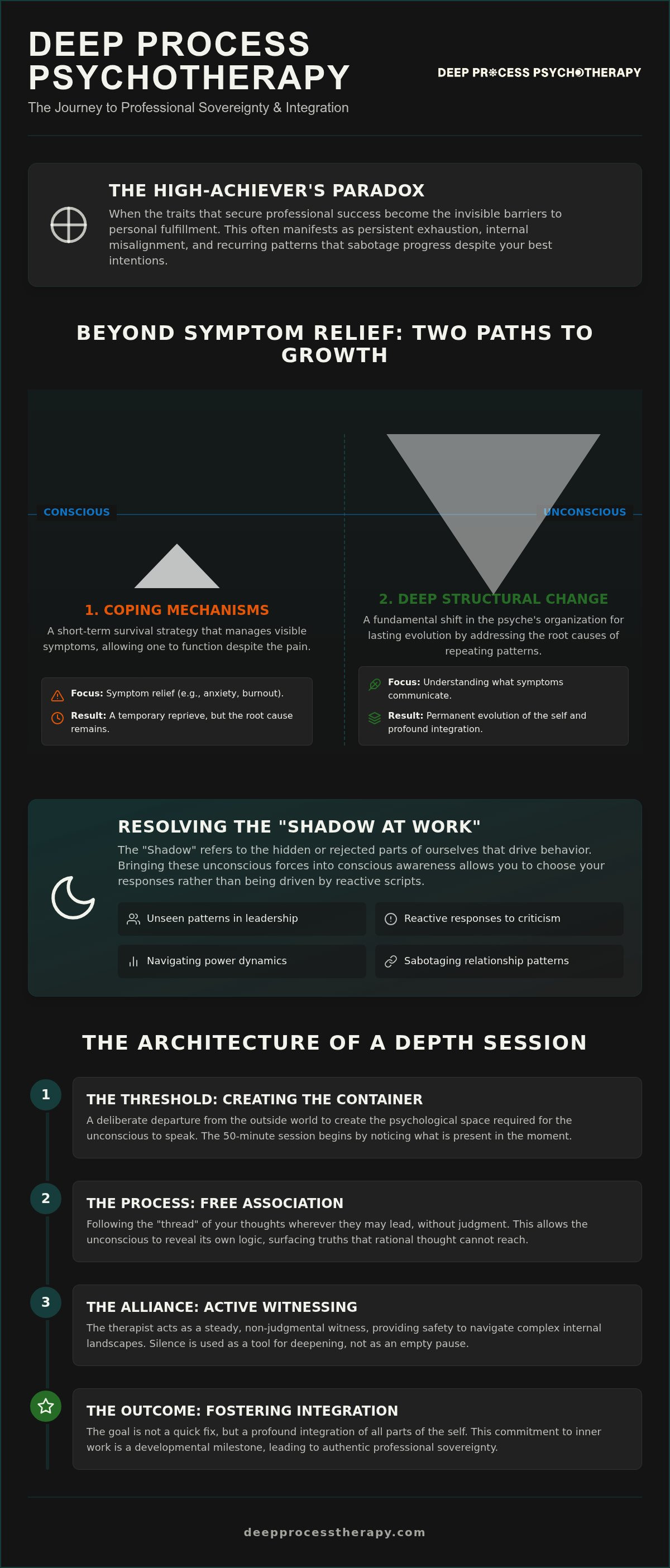
There's a fundamental distinction between developing coping strategies and achieving structural psychological change. Coping is a necessary, short-term survival mechanism that allows us to function despite our pain. However, structural change involves a fundamental shift in how the psyche is organised. It addresses the root causes of why certain patterns repeat, ensuring that growth isn't just a temporary reprieve but a permanent evolution of the self. For the high achiever, this means moving beyond fixing a "problem" and toward a state of profound integration.
The unconscious mind plays a silent yet dominant role in shaping daily decisions and professional outcomes. Unseen forces often dictate how we lead, how we respond to criticism, and how we navigate power dynamics. By bringing these unconscious drives into the light of conscious awareness, we gain the sovereignty to choose our responses rather than being driven by ancient, reactive scripts. This clarity is essential for those who find their traditional success shadowed by an inexplicable sense of being stuck.
The Shift from Wellness to Depth
Modern culture often conflates wellness with self-care rituals that, while pleasant, rarely touch the core of our suffering. Surface-level interventions can inadvertently bypass the very emotions that require our attention. True depth work requires a willingness to stay with difficult feelings, allowing them to unfold within the safe container of the session. This process isn't about feeling better in the moment; it's about becoming better at feeling, which is the cornerstone of emotional resilience.
Therapy as a Developmental Milestone
Engaging in long-term therapy is a proactive choice for those who value self-sovereignty over reactive living. In a world that demands instant results, the steady pace of individual psychotherapy sessions offers a necessary counter-rhythm. It establishes a "laboratory" for the self, where you can experiment with new ways of being and relating. This commitment to inner work is a developmental milestone, marking the transition from a life shaped by external expectations to one guided by internal purpose and stability.
The Architecture of a Session: What to Expect in Depth Work
The threshold of a session marks a deliberate departure from the noise of the outside world. Entering into individual psychotherapy sessions requires a slowing of the pulse and a turning of the gaze inward. This transition isn't just a formality. It's a psychological necessity. By setting aside the immediate demands of professional life, the individual creates the space required for the unconscious to speak. The session begins not with a checklist, but with an invitation to notice what is present in the immediate moment.
Unlike more directive approaches to psychotherapy, depth work often relies on the practice of free association. You are encouraged to follow the "thread" of your thoughts wherever they lead, even if they seem tangential or trivial. The therapist acts as a steady, non-judgmental witness, holding the boundaries of the space so you can explore the deeper corners of your psyche without fear of being lost. This process allows the unconscious to reveal its own logic, surfacing truths that logic alone cannot reach.
The Mechanics of Deep Reflection
Within this container, the therapist employs active listening to detect subtle shifts in tone or recurring themes that you might overlook. The therapeutic hour is a 50-minute clinical standard. Silence is never empty in this context. It's a tool for deepening. These pauses allow for the resonance of an idea to settle, prompting a level of self-discovery that rapid-fire dialogue often obscures. This methodical pace ensures that insights are felt, not just understood intellectually.
Navigating the Unconscious Material
The work often involves examining dreams, metaphors, and recurring emotional themes that act as doorways to the shadow self. These elements reveal the hidden parts of our personality that influence our behaviour from behind the scenes. Identifying these shadow elements requires a safe environment where vulnerability is met with professional stability. If you feel ready to explore these internal landscapes, engaging in 1:1 therapy can provide the necessary framework for this evolution.
As the session draws to a close, the focus shifts toward integration. We don't simply leave the insights on the chair. Instead, we consider how the day's discoveries might inform your actions and perspectives in the week ahead. This closing ritual ensures that the work done in the laboratory of the session begins to permeate your external reality, fostering a sense of internal stability that remains even after you leave the room.
Resolving the Shadow at Work: Therapy for Professional Growth
High-stakes career environments often act as mirrors for our unresolved internal conflicts. Unconscious self-sabotage isn't a lack of skill; it's a manifestation of parts of the self that remain unintegrated. By engaging in individual psychotherapy sessions, professionals can begin to identify the "Shadow at Work"-those hidden impulses that lead to sudden friction with colleagues or unexpected hesitations in high-stakes decision-making. These patterns often involve projecting our own unacknowledged traits onto leaders or peers, creating a distorted view of the organisational landscape. When we perceive "arrogance" or "incompetence" in others with disproportionate intensity, we're often seeing a disowned part of our own history reflected back at us.
For many, understanding psychotherapy sessions as a tool for career development marks a significant shift in perspective. Burnout, for instance, is rarely just a result of a heavy workload. It's often the consequence of an internal exhaustion that arises when our "doing" is disconnected from our "being." Addressing the psychological roots of this exhaustion allows for a more sustainable approach to achievement. It transforms emotional intelligence from a conceptual skill into a lived experience of deep internal awareness, allowing you to lead from a place of presence rather than pressure.
Leadership and the Integrated Self
Authentic leadership is impossible without a thorough understanding of one's own triggers. When a leader hasn't integrated their shadow, they're likely to react defensively to challenge or drive their team toward unsustainable goals to satisfy an internal need for validation. Breaking the cycle of chronic overachievement requires a pause to examine what truly drives the constant "doing." Internal stability is the bedrock of organisational impact, providing a steady anchor amidst the volatility of the corporate world. This stability isn't a static state but a dynamic balance maintained through ongoing reflection.
Transforming Professional Friction
Individual psychotherapy sessions provide a rare opportunity to deconstruct recurring team dynamics from a safe distance. By developing the "observer self," you can learn to navigate workplace politics with integrity rather than reactivity. This perspective allows you to see the archetypal roles being played out in meetings and conflicts. Integrating the shadow reduces interpersonal conflict in corporate settings by preventing the unconscious projection of personal frustrations onto professional colleagues. This internal work doesn't just change how you feel; it changes how you influence the world around you, fostering a culture of clarity and mutual respect.
The Therapeutic Alliance: Why the Relationship is the Catalyst
The therapeutic alliance is the primary vehicle for change. It's the silent architecture of the work. While techniques and theories provide a necessary framework, the relationship itself acts as the catalyst for profound internal transformation. Within individual psychotherapy sessions, the therapist offers a steady presence, a calm anchor that remains unmoved by the client's internal storms. This stability allows for a level of vulnerability that is rarely possible in other areas of life. It creates a sanctuary where the psyche can begin to reveal its hidden dimensions without the fear of judgement or abandonment.
The session often functions as a mirror, reflecting the external relationship patterns that define your professional and personal life. By observing these dynamics through the lens of transference and counter-transference, you can explore your relational habits within the safety of the therapeutic hour. You might notice how you seek approval from the therapist in the same way you do from a senior executive, or perhaps you find yourself withdrawing when the conversation touches upon a vulnerable theme. Seeing these patterns in real-time allows you to deconstruct them without the real-world consequences that usually follow such revelations.
This process of safe exploration is governed by a strict ethical framework that is central to private practice in the United Kingdom. Professional standards for registration in 2026 require a rigorous commitment to boundaries and confidentiality, ensuring that the space remains sacred and secure. These ethics aren't merely administrative hurdles; they are the very conditions that make deep work possible. Knowing that your internal landscape is held within a confidential, professional container provides the psychological safety required to venture into the more difficult territories of the self.
Finding the Right Steadfast Guide
Choosing a therapist is a significant developmental step. It's about finding a guide who can handle the weight of deep process work. While many are clinical experts, a true guide also possesses the philosophical depth necessary to navigate complex existential territory. Trust isn't granted at the first meeting; it's a foundational element that is built through consistent, reliable engagement over time. If you are seeking this level of professional support, you can start your journey with 1:1 therapy to establish this vital connection. This relationship becomes the bedrock upon which all other growth is built.
The Commitment to the Process
Consistency in individual psychotherapy sessions leads to better long-term outcomes because it provides the rhythmic support the psyche needs to unfold naturally. The "middle phase" of therapy is often where the most significant structural change occurs, yet it's also where resistance typically surfaces. You might feel a sudden desire to pull away or find yourself questioning the value of the work just as you approach a significant breakthrough. Navigating this resistance is part of the evolution from reactive crisis-management to a deeper state of self-discovery. This gradual unfolding requires patience and a commitment to staying with the process even when the path feels uncertain.
Deep Process Psychotherapy: Sovereignty through Individual Sessions
Deep Process Psychotherapy offers a pathway to internal sovereignty that respects the complexity of the human experience. Our approach is rooted in the belief that true transformation requires more than surface-level adjustments; it demands a thorough integration of the disowned parts of the self. Through individual psychotherapy sessions, we provide the steady anchor needed to navigate these internal landscapes, balancing clinical rigour with a profound philosophical inquiry. This process doesn't just resolve immediate distress. It fosters a more whole, authentic version of the self capable of navigating high-stakes environments with clarity.
As you integrate the shadow, the impact of the work begins to radiate outward. The internal stability cultivated in 1:1 sessions becomes the bedrock for your professional presence and personal relationships. This transition from the therapeutic laboratory to the world is the ultimate aim of our practice. It's about moving from a life of unconscious reaction to one of conscious choice and sovereignty. By aligning your internal world with your external ambitions, you create a life that's both successful and deeply meaningful.
Our Methodology: The Shadow and Beyond
We focus on the long-term evolution of the individual rather than the delivery of quick, temporary fixes. By utilising The Shadow At Work framework, we help career-focused individuals identify the hidden patterns that hinder their growth. This methodology creates a stable container for exploration, allowing you to confront difficult truths without losing your footing. It's an invitation to step into a more integrated way of being, where your professional impact isn't undermined by unresolved psychological themes. This foundational work often precedes the collective shifts explored in our Corporate Workshops.
Beginning the Work
The journey begins with an initial consultation, a space designed to assess fit and set clear intentions for the work ahead. This is a time to determine if our steady, depth-oriented approach aligns with your current needs and developmental goals. For those seeking ongoing reflection between sessions, our Substack Newsletter provides regular insights into the intersection of depth psychology and professional life. This resource serves as a companion to the deeper work, offering a steady stream of thoughtful inquiry to support your ongoing growth.
If you feel ready to move beyond coping and toward a state of profound integration, you can enquire about individual psychotherapy sessions with Deep Process Psychotherapy. This is the first step toward reclaiming your internal sovereignty and establishing a more purposeful path forward. We invite you to engage in this work with the patience and seriousness it deserves, allowing the process to unfold at its own natural pace.
The Path Toward Internal Sovereignty
The journey from reactive survival to internal sovereignty requires a willingness to look beneath the surface of traditional success. We've explored how individual psychotherapy sessions move beyond symptom management to address the structural architecture of the psyche, particularly through the integration of the shadow self. This process isn't a quick fix; it's a methodical evolution grounded in clinical expertise and philosophical depth.
By understanding the unconscious patterns that influence your leadership and relationships, you gain the stability needed to navigate complex professional landscapes with integrity. Deep Process Psychotherapy serves as a steadfast guide for high-achievers ready to undertake this profound transformation. It's a commitment to your long-term evolution and the reclamation of your authentic purpose. If you're ready to bridge the gap between psychological theory and your daily reality, we invite you to take the first step.
Begin your deep process: Book an initial psychotherapy consultation
The path toward personal wholeness remains open to those who approach their internal world with patience and serious reflection.
Frequently Asked Questions
What is the difference between individual psychotherapy and coaching?
Psychotherapy addresses the underlying psychological structures and unconscious patterns that shape behaviour, whereas coaching typically focuses on conscious goal-setting and performance. While coaching is often future-oriented and instructional, individual psychotherapy sessions delve into developmental history to resolve deep-seated internal conflicts. This clinical depth allows for structural change rather than just tactical improvement. It's a shift from learning how to do to understanding who you are.
How long does a typical psychotherapy session last?
A typical psychotherapy session follows the "therapeutic hour" standard, which is 50 minutes of clinical contact time. This duration is intentionally chosen to provide enough space for deep reflection without causing psychological fatigue. The remaining 10 minutes of the hour are used by the therapist for clinical notes and preparation. This rhythmic consistency ensures that every engagement has a clear beginning, middle, and end, fostering a sense of safety.
Do I need a GP referral for private psychotherapy in the UK?
You don't need a GP referral to access private psychotherapy in the UK. Most individuals choose to self-refer to maintain a higher level of privacy and to select a therapist whose philosophical approach aligns with their personal growth goals. As of 2026, private practitioners must meet rigorous national registration standards, ensuring high levels of clinical safety and professional accountability. This path allows you to begin the work based on your internal readiness.
What happens if I don’t have a specific problem but just want to grow?
Depth-oriented therapy is ideally suited for those who seek expansion rather than just repair. You don't need to be in crisis to benefit from individual psychotherapy sessions; in fact, many high-achievers engage in this work to achieve greater self-sovereignty and internal stability. This process serves as a developmental milestone, allowing you to move from reactive living to a life guided by conscious purpose and a more integrated sense of self.
Is individual therapy effective for career burnout?
Psychotherapy is highly effective for burnout because it addresses the psychological roots of exhaustion rather than just the external symptoms. Burnout often signals a disconnection between one's internal values and their professional output. By exploring these underlying drivers, you can move beyond temporary rest toward a sustainable way of working. This work helps you identify the unconscious scripts that lead to chronic overachievement and the neglect of your own internal needs.
How many sessions will I need before I see a change?
The number of sessions required varies significantly depending on the depth of the work and your specific intentions. Structural psychological change is a gradual process that unfolds over months or years rather than weeks. While some individuals notice a shift in their internal perspective after a few months of consistent engagement, the long-term evolution of the self is an ongoing journey. We focus on sustainable growth that persists well beyond the therapeutic hour.
Can psychotherapy sessions be conducted online?
Psychotherapy sessions can be conducted online, providing a flexible option for professionals with demanding schedules or those living outside major metropolitan areas. Research and clinical practice have shown that the therapeutic alliance can be just as strong in a digital environment as it is in person. The key is ensuring a private, quiet space where you can engage in deep reflection without interruptions, maintaining the sanctity and focus of the clinical container.
What is shadow work and is it included in individual sessions?
Shadow work involves identifying and integrating the disowned or unconscious parts of your personality. These elements often influence your professional behaviour and personal relationships in ways you don't consciously intend. Within our practice, this framework is a central component of the work. It allows you to reclaim hidden strengths and resolve the internal frictions that hinder your growth, leading to a more authentic and whole version of yourself as you navigate complex landscapes.